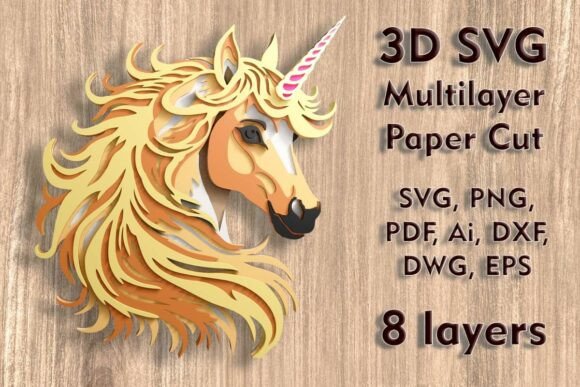
Unicorn 3D SVG Multilayer PaperCut Files
A Designer’s First Glance: Whimsy with Structural Intelligence
Opening Unicorn 3D SVG Multilayer PaperCut Files, I didn’t just see a fantasy motif—I saw architecture. The layered silhouette—mane, horn, ears, and base shadow—doesn’t float; it stacks. It breathes dimension without relying on excessive gradients or forced perspective. That matters when translating into embroidery: each layer translates cleanly to stitch order, especially in applique design or multi-stage fill stitch builds. As someone who regularly adapts paper-cut aesthetics for machine embroidery design, I appreciate how the 250 x 225 mm footprint (9.85 x 8.85 in) gives breathing room for satin stitch curves and smooth horn tapering—no frantic digitizing compromises needed.
Real-World Test: A Custom Embroidered Baby Pillow Cover
Last week, I prepped Unicorn 3D SVG Multilayer PaperCut Files for a client’s nursery pillow cover—organic cotton twill, medium-weight stabilizer, soft pastel thread palette. The design scaled beautifully to 180 mm wide without losing horn definition or ear contour. On fabric, the layered effect translated into subtle depth: the horn lifted slightly with a tight satin stitch cap, the mane flowed in directional fill stitch, and the base shadow used a low-density running stitch outline to ground the piece visually. Customers notice that nuance—it reads as “hand-finished,” not digital. For Etsy sellers or boutique owners building trust through tactile quality, this kind of clarity builds credibility fast.
Where It Shines—and Where to Pause
Unicorn 3D SVG Multilayer PaperCut Files excels in mid-to-large format applications: sweatshirt embroidery (center chest or back), tote bag design, pillow covers, tea towels, and nursery decor. Its clean lines hold up across fabric textures—from linen blends to brushed cotton—without bleeding or distortion. It also works well as an embroidered patch, especially when backed with tear-away stabilizer and finished with merrow edging.
But caution is built into the specs: “be careful in reducing the design, consider thin elements.” That’s not marketing fluff—it’s a designer’s note I’d write myself. Reduce below ~140 mm, and the inner horn curve and delicate mane strands risk becoming unstable in fill stitch density. On stretchy fabric like jersey or curved surfaces like caps, those fine layers need extra stabilization and slower stitching speeds. Dark fabric? Test contrast early—light thread on black can mute the 3D illusion unless you add underlay or adjust stitch direction for light catch.
Fabric & Function Checkpoints
- Thin fabric (e.g., baby onesies): Use cut-away + topping; avoid dense fill areas near seams.
- Textured fabric (e.g., terry cloth towels): Increase underlay, reduce stitch count in shadow zones to prevent puckering.
- Layered garments (e.g., hoodies with pockets): Confirm hoop size clears seam allowances—this design’s width demands at least a 6” x 10” hoop.
- Holiday embroidery or personalized gifts: Pair with simple monogram scripts—not competing flourishes—to keep focus on the unicorn’s gentle presence.
Commercial Craftsmanship: What This Design Says About Your Brand
When your small shop product features Unicorn 3D SVG Multilayer PaperCut Files, it quietly signals intentionality. Not just “cute unicorn”—but thoughtful layering, balanced negative space, and scalable elegance. That elevates perceived value for handmade product buyers. For craft fair vendors or Etsy sellers listing custom apparel, it’s a versatile anchor design: swap thread colors for gender-neutral palettes, simplify layers for kids’ caps, or combine with coordinating stars or clouds from the same Fantasy And Fairy Tales collection.
It also supports strong printable mockups. Because the SVG structure is clean and vector-based, it renders crisply in both color and grayscale previews—critical when selling digital embroidery files or showing clients how a sweatshirt embroidery will land before stitching begins.
Practical Designer Notes Before You Stitch
- Always test Unicorn 3D SVG Multilayer PaperCut Files on scrap fabric matching your final project’s weight and stretch.
- Check thread color contrast on both light and dark backgrounds—especially where layers overlap.
- Review stitch density in the horn tip and inner ear; adjust if needed for your fabric + stabilizer combo.
- Confirm hoop size compatibility—don’t assume standard 4” x 4” will suffice.
- Inspect small details at actual stitch-out scale: does the shadow edge read clearly, or blur?
- Test black-and-white mockups to assess silhouette strength without color distraction.
- Verify licensing terms before using in commercial embroidery, digital product sales, or client work—3D SVG files often carry specific usage boundaries.
Final Thought: A Design That Grows With Your Projects
Unicorn 3D SVG Multilayer PaperCut Files isn’t just a download—it’s a design partner. It adapts to baby embroidery with tenderness, holds its own on bold sweatshirt embroidery, and adds quiet sophistication to holiday embroidery or wedding gift totes. Its strength lies in restraint: no overworked details, no visual noise, just confident shape language that translates faithfully from screen to stitch. For embroidery designers, craft business owners, and creative entrepreneurs who value clarity over clutter, this is the kind of digital embroidery file that earns repeat use—not because it’s trendy, but because it works, thoughtfully, every time.