Pirate Ship 3D SVG for Ornaments & Decor
As a graphic designer who’s built brand identities for indie toy makers, seasonal pop-ups, and Etsy-based handmade businesses, I recently evaluated the Pirate Ship 3D SVG Multilayer Paper Сut for a client launching a nautical-themed children’s activity kit. My goal wasn’t just to see if it “looks cool”—it was to ask: Does this asset strengthen the brand story? Does it hold up across print, digital, and physical product applications? And most critically—does it behave predictably in real-world design workflows?
A First Impression That Sets the Tone
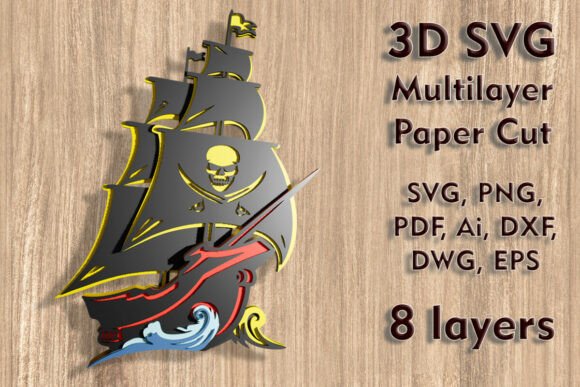
Opening the file, I immediately noticed the layered depth—the mast, sails, hull, and wave base each sit on distinct vector layers, with subtle shadow offsets that imply dimension without overcomplicating the silhouette. It reads as playful but intentional—not cartoonish, not overly detailed, and definitely not generic clipart. The mood is adventurous, nostalgic, and tactile—perfect for brands leaning into handmade charm, storytelling, or experiential packaging. It feels like a graphic design asset made for emotional resonance, not just decoration.
Where This Pirate Ship 3D SVG Multilayer Paper Сut Shines
In our client project, we used it across three key touchpoints—and each time, it elevated the visual cohesion:
- Product mockups: Placed on a kraft-box prototype, the layered cut lines translated beautifully into embossed foil accents—giving the unboxing moment instant thematic weight.
- Social media graphics: As a hero element in Instagram carousels and Pinterest pins, its bold profile held attention even at thumbnail size. Paired with a clean sans serif headline, it created strong visual hierarchy without competing for focus.
- Printable wall art & Cricut projects: The 250 H × 190 W mm dimensions scaled cleanly to 12×16” shadow box frames. Thin elements—like rigging lines and sail folds—remained crisp when cut on cardstock, confirming solid vector construction.
It also performed well in packaging design, where we applied simplified versions of the sail layer as die-cut windows on gift boxes. For sticker design and t-shirt design, the SVG’s clean paths meant easy color separation and smooth sublimation output. Even in Canva templates for small business owners, it dropped in without distortion—no pixelation, no alignment drift.
Where Caution Is Essential
This isn’t a one-size-fits-all SVG design. Its strength lies in expressive context—not minimalism. I’d avoid using the full multilayer version in:
- Logo design or primary brand marks—it’s too specific and dimensional for scalable identity systems.
- Small-format applications like QR code badges or tag labels under 25 mm wide; thin structural lines risk vanishing during print or cut.
- Corporate or B2B marketing visuals where tone leans formal—this asset thrives in handmade business and small business branding, not boardroom decks.
- Crowded layouts with dense text or complex backgrounds—the ship’s character demands breathing room to land emotionally.
Design Judgment: Beyond Aesthetics
What makes the Pirate Ship 3D SVG Multilayer Paper Сut commercially viable isn’t just its look—it’s how it supports brand consistency and audience engagement. In our client’s case, parents told us the packaging “felt like part of the adventure,” which directly tied to higher unboxing shares and repeat purchases. That kind of emotional appeal doesn’t happen by accident—it happens when a creative design asset aligns with audience expectations and execution discipline.
Crucially, it reinforced visual trust: the clean vector paths, consistent stroke weights, and logical layer naming signaled professionalism—not just another clipart download. That perception matters when your client is selling premium-priced kits on Etsy or through local boutiques.
Practical Designer Notes Before You Use It
Before clearing this for a client project, I always run these checks:
- Test in black and white—verify contrast holds on both light and dark backgrounds.
- Preview at 10%, 50%, and 200% scale—especially watch thin masts and rope details at reduced sizes.
- Drop it onto real product mockup files (not just flat previews) to assess spatial balance.
- Run a test print on your intended stock—cardstock, kraft paper, or vinyl—to confirm cut-line fidelity.
- Confirm SVG editability: open in Illustrator or Inkscape, ungroup layers, and adjust colors or remove elements without breaking paths.
- Compare typography pairings: it harmonizes best with friendly sans serifs (like Poppins or Nunito) and warm display fonts—but clashes with ultra-thin serifs or rigid monospaced styles.
- Verify commercial license terms—this is non-negotiable for print-on-demand, Etsy product, or client-facing deliverables.
Final Verdict: A Thoughtful Addition to Your Design Assets
The Pirate Ship 3D SVG Multilayer Paper Сut isn’t background filler—it’s a digital product with narrative intent. When matched to the right creative marketplace context—seasonal campaigns, themed merchandise, educational kits, or boutique retail—it adds texture, warmth, and memorable distinction. It fits naturally within a design bundle focused on ornaments, 3D SVG decor, or immersive printable experiences.
For designers building marketing visuals, editorial design, or web design for lifestyle brands, this asset earns its place—not because it’s trendy, but because it performs with integrity across formats, scales thoughtfully, and respects the craft behind both digital and physical making. Just remember: it’s a supporting actor, not the lead. Use it with purpose, test it rigorously, and let it do what it does best—bring dimension, delight, and authenticity to real client work.