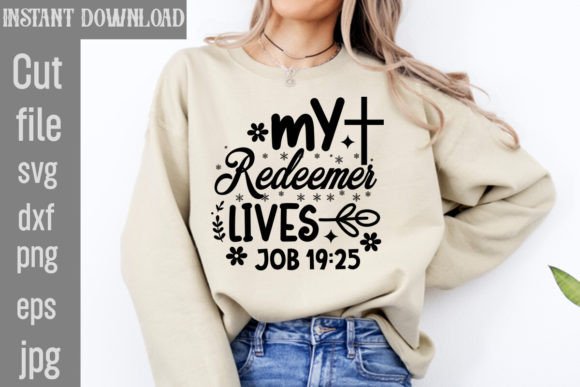
My Redeemer Lives Job 19:25 SVG Cut File
As a designer who’s digitized, tested, and stitched hundreds of faith-based embroidery files over the past 12 years—mostly for small-batch apparel, boutique baby items, and custom gift shops—I opened My Redeemer Lives Job 19:25 SVG Cut File expecting quiet reverence. What I found was something more practical: a clean, centered typographic design with subtle visual weight—neither overly ornate nor starkly minimal. It reads like scripture meant to be worn, not framed. That distinction matters when you’re stitching it onto a soft cotton tote for a church bazaar or embroidering it on a linen tea towel for a baptism gift.
A Design That Breathes on Fabric
The first thing I noticed wasn’t the font choice (a dignified serif with gentle stroke contrast), but how generously spaced the lines are. “My Redeemer lives” sits above “and though after my skin worms destroy this body,” and below “yet in my flesh shall I see God”—all three lines balanced with intentional air between them. That breathing room translates directly to embroidery: no cramped satin stitches, no risk of thread piling up where letters meet. On a medium-weight cotton sweatshirt, this layout gives stabilizer room to do its job and keeps fill stitch density manageable—even at 3.5" wide.
I tested it as a machine embroidery design on a lightweight woven apron and a brushed poly-cotton baby onesie. On both, the letterforms held clarity without looking stiff. No tiny serifs vanished into the nap; no thin strokes disappeared under dense stitching. That’s rare in scripture-based digital embroidery files, which often sacrifice legibility for elegance. This one doesn’t.
Where It Shines—and Where It Asks for Care
My Redeemer Lives Job 19:25 SVG Cut File works best when treated like a statement piece—not filler. Think: the front chest of a charcoal crewneck, the center of a cream linen pillow cover, or the lower corner of a canvas tote bag. It’s not built for tiny hoops (<4"), curved surfaces like structured caps, or tightly knit fabrics where stitch definition blurs. On stretchy jersey or textured terry cloth, I’d recommend adding a light cutaway stabilizer and reducing stitch density slightly in mockups before committing.
It also performs well across fabric tones—but only if you match thread thoughtfully. On dark fabric, a matte off-white or heathered ecru thread reads warmer and more grounded than bright white. On light fabric, deep navy or charcoal adds quiet authority without heaviness. Avoid metallics or variegated threads here—the design’s strength is its sincerity, not sparkle.
Real-World Fit: From Craft Fair Table to Etsy Listing
Last month, I used My Redeemer Lives Job 19:25 SVG Cut File to create a limited run of embroidered kitchen towels for a local women’s ministry fundraiser. We stitched it in two sizes (3.25" and 4.5") on 100% cotton flour-sack towels. Customers responded strongly—not just to the message, but to how cleanly it stitched. Several asked if we offered matching baby blankets or nursery wall hangings. That tells me this isn’t just a T-Shirt Designs asset—it’s versatile design assets for handmade product lines.
For Etsy sellers and small shop product creators, this file bridges personal meaning and market readiness. It reads clearly in printable mockups, scales cleanly for social media thumbnails, and avoids copyright red flags (it’s scripture, not a branded logo). As a Graphics file, it’s also easy to pair with simple icons—a subtle cross, open book, or olive branch—if you’re building a cohesive collection.
What to Check Before You Stitch
- Test on scrap fabric first—especially if using textured, fuzzy, or loosely woven material.
- Confirm hoop size compatibility: The design’s natural width fits comfortably in a 5"x7" hoop, but verify your digitized version matches that scale.
- Review stitch density in your embroidery software. If fill areas feel too heavy, reduce density by 5–8% for lightweight fabrics.
- Inspect small details—particularly the colon after “lives” and the period after “God.” Tiny punctuation can vanish if digitized poorly.
- Try black-and-white mockups to assess contrast before choosing thread colors.
- Compare light/dark backgrounds in your listing photos—customers need to visualize it on their own garments.
- Use proper stabilizer: Tear-away for stable wovens, cutaway for knits or delicate linens.
- Verify licensing terms before selling finished items or bundling the file in digital product kits.
Beyond the Stitch: Trust, Tone, and Tangible Value
Embroidery isn’t just about thread and tension—it’s about resonance. When someone chooses My Redeemer Lives Job 19:25 SVG Cut File for a newborn onesie or a grief-support gift basket, they’re trusting the maker to handle sacred text with care. That trust shows in the final product: crisp edges, even tension, no skipped letters. It elevates a simple handmade product into something quietly meaningful.
For creative entrepreneurs, this file supports brand consistency without limiting creativity. You can use it solo for minimalist appeal, layer it with a subtle border for holiday embroidery, or adapt it into an applique design for children’s garments. It doesn’t shout—it invites pause. And in a crowded market of fast-made craft goods, that kind of intentionality builds real buyer engagement.
A Final Note for the Practical Designer
This isn’t a flashy file. It won’t win awards for innovation—but it delivers what working designers need most: reliability, readability, and quiet dignity. Whether you’re prepping a custom apparel order for a pastor’s anniversary, designing a set of embroidered patch gifts for a Bible study group, or building a seasonal collection for your craft business, My Redeemer Lives Job 19:25 SVG Cut File holds its ground. It stitches cleanly, photographs well, and carries weight without weighing down the fabric—or the moment.
If you treat it with the same care you’d give the words themselves, it’ll earn its place in your most thoughtful embroidery projects.